Oracle APEX / AI Essay
APEX in the AI Era: The Missing Feedback Loop
APEX does not just need more AI generation. It needs better feedback loops so developers can trust change.
I have been using Oracle APEX since 2005. I am not writing this as someone looking at the platform from the outside. I have built with APEX, maintained it, migrated it, explained it to customers, and trusted it for real enterprise work. My argument is simple: APEX does not just need more AI generation. It needs better feedback loops so developers can trust change.
APEX succeeded because it solved the original problem well: it gave Oracle developers a fast way to turn tables, views, SQL, and PL/SQL into useful web applications. In 2005, that mattered. APEX gave database developers a ready kitchen when the alternative was building the restaurant before cooking the meal. But successful platforms create new problems. Many APEX applications that started small became important, long-lived systems. A page became a module. A report became a workflow. A quick internal app became part of daily operations.
Over time, these systems collected pages, shared components, dynamic actions, LOVs, authorization rules, JavaScript, reports, integrations, and deployment history. The original challenge was fast creation. The current challenge is safe change. APEX did not fail here; it succeeded into a maintenance problem, the way a small town becomes a city and suddenly needs traffic signals, maps, and zoning rules.
LLM-Valid Is Not The Same As Trusted
AI makes that shift more urgent. If machines can generate pages, reports, processes, and valid APEXlang faster, developers need better feedback before those changes become risk. A generated application can be syntactically valid and still be wrong: the wrong authorization scheme, a missing org filter, an unsafe download, a broken LOV dependency, or a feature that cannot deploy to the customer's runtime.
APEXlang and its grammar are important because they make APEX metadata more readable and toolable, but readable files alone are not enough. A grammar can make the sentence valid; it cannot make the decision safe. LLM-valid output is not the same as developer trust.
This problem exists across modern software. A Rails route change can expose an endpoint. A Django permission change can leak data. A React state change can break a workflow. A Phoenix LiveView event can update the wrong state. A SQL change can remove tenant filtering. The difference is that APEX is a special case because so much application behavior is already captured as metadata. That should make APEX one of the best platforms for developer-facing feedback loops, if the metadata is connected.
The Developer Becomes The Wiring Diagram
Most experienced APEX developers know the pain. The hard part is often not creating a page. It is opening an existing application and asking: why is this button hidden, which item triggers this dynamic action, which authorization scheme protects this region, which LOV feeds this validation, and what breaks if I change this process?
APEX usually has the information somewhere: Page Designer, Shared Components, Application Utilities, Advisor, Change History, Database Object Dependencies, Debug, Activity Logs, Compatibility Mode, exports, checksums, APEX views, and now APEXlang. The problem is not absence. The problem is fragmentation and delay. The developer becomes the human wiring diagram.
Donella Meadows' systems thinking helps explain why this matters. In a complex system, the problem is often not lack of parts; it is delayed feedback. APEX applications are systems of metadata, rules, dependencies, and timing. When a developer changes an LOV, authorization scheme, process, or dynamic action, the effect may not appear where the change is made. It may surface later as a broken validation, exposed report, failed deployment, or production defect.
That is like changing a valve in a building and discovering later that water pressure failed on another floor. The missing layer is feedback at the moment of change.
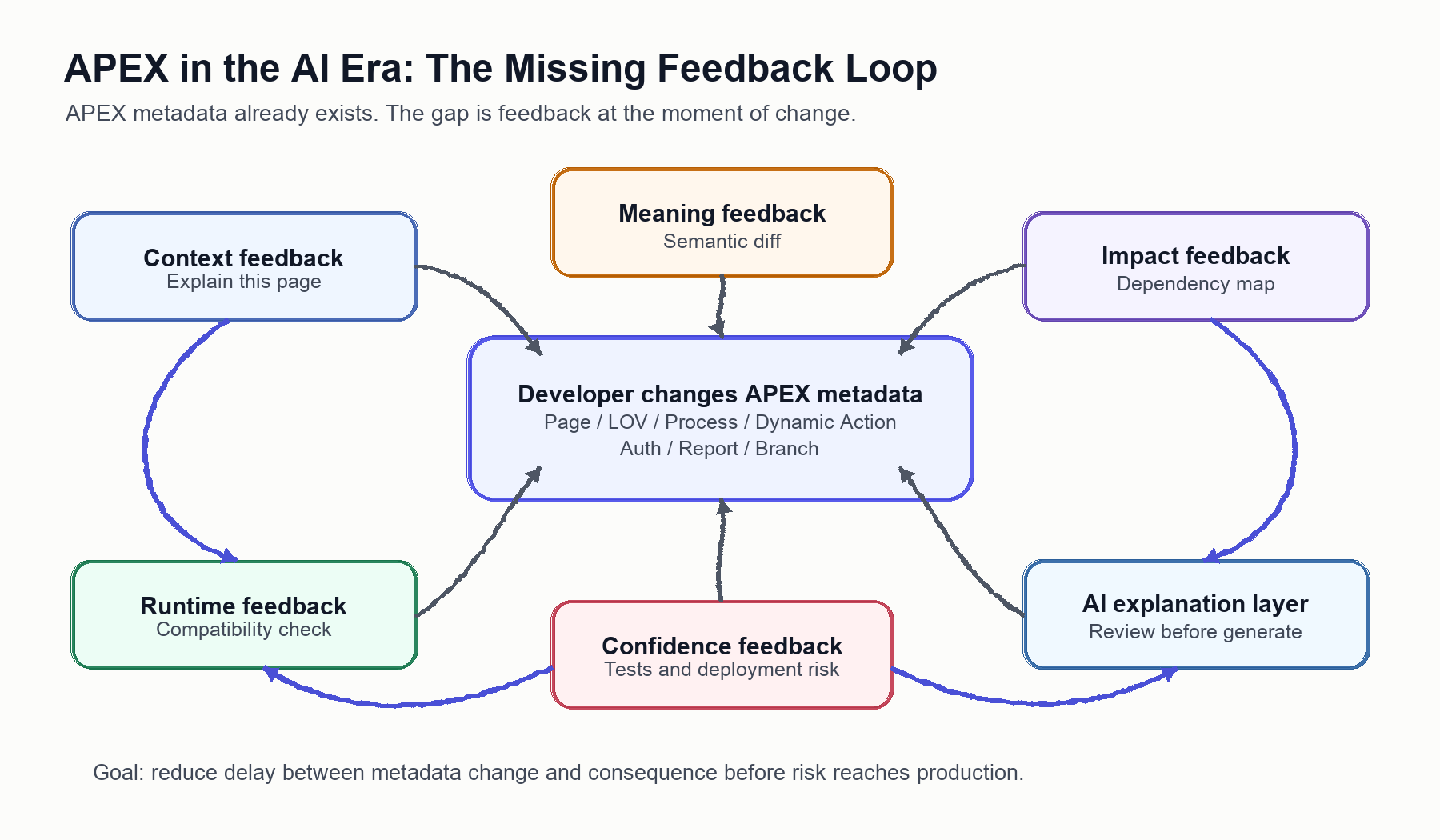
Metadata Intelligence At The Moment Of Change
The diagram above shows the missing loop. A developer changes APEX metadata in the center: a page, LOV, process, dynamic action, authorization rule, report, or branch. Around that change, APEX should provide feedback before risk reaches production.
That feedback layer should be a metadata intelligence system. Context feedback explains the page: what it does, what data it uses, what security applies, and what risks exist before I touch it. Meaning feedback explains the change: did I change a label, or remove authorization from a sensitive region? Impact feedback maps dependencies across items, LOVs, dynamic actions, validations, reports, processes, branches, JavaScript, and authorization schemes.
Runtime feedback checks whether the application can run on the target APEX version. Confidence feedback shows what passed, what is missing, what security changed, and what sensitive data may be exposed. AI sits across these loops as the explanation layer, helping developers understand risk before release.
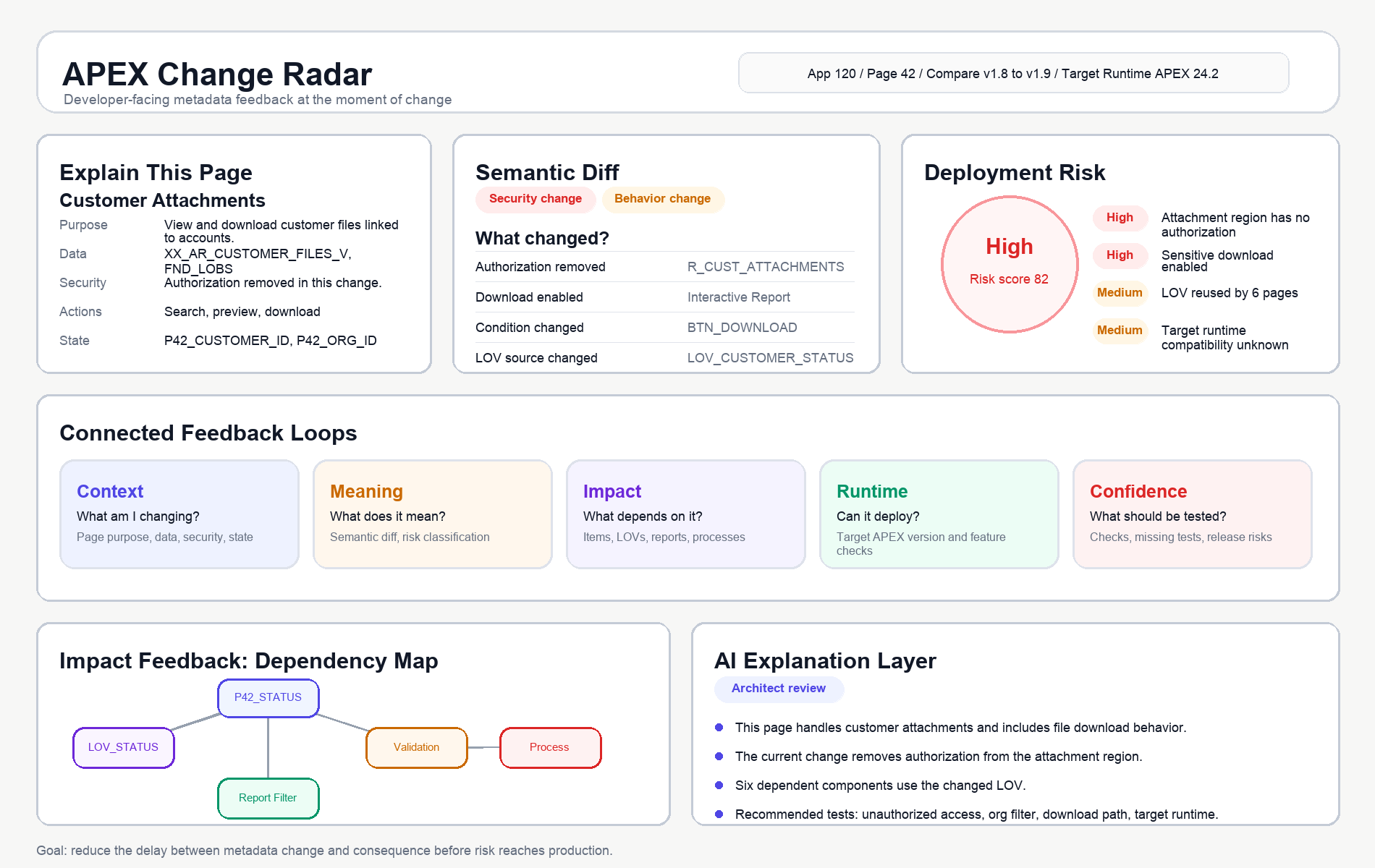
A Cockpit For APEX Change
This is the practical shape of the idea: an APEX developer feedback console. Open a page, compare it to a baseline, choose a target runtime, and see the page explanation, semantic changes, dependency impact, risk flags, suggested tests, and AI review in one place. Not another report catalog. A cockpit and pre-flight checklist for APEX change.
If APEX does not provide this system, developers will still build it around the platform using custom dictionary reports, SQL against APEX views, manual spreadsheets, export scanners, Git diffs, review checklists, and tribal knowledge from senior developers. Those workarounds help, but they keep the map outside the platform: in side reports, spreadsheets, scripts, and senior developers' heads.
The so what is simple: creation is getting cheaper, but safe change is getting more valuable. APEX can reduce production risk, make AI-generated work reviewable, and keep long-lived applications maintainable by turning metadata into feedback at the moment of change. In the AI era, the platform that wins is not the one that generates the most screens or code. It is the one that helps teams trust change.
For related writing on AI, enterprise systems, and Oracle application modernization, see the articles section.